Today's Guide to the Marketing Jungle from Social Media Examiner...
presented by 
Friday is almost here, Alluser! Before you unplug, here are the latest AI insights and updates for marketers. Whether you read them now or save them for later, you won't want to miss these.
In today's edition:
-
Using AI focus groups to guide your marketing
-
Why most prompting fails and what to do instead
-
🗞️ Industry news from Anthropic, ChatGPT, and more

Getting Actionable Insights from AI Focus Groups
Want a smarter, more strategic way to use AI for insight—not just output? What if you could test your marketing ideas with your ideal customers before you ever hit publish?
Christopher Pemm takes a closer look at a practical, structured way to use generative AI: running synthetic focus groups built from tightly defined customer profiles. Instead of asking AI broad, generic questions (and getting equally generic answers), the approach centers on translating your ideal customer profiles into concise, structured "character cards" that reflect how your buyers think, decide, and prioritize.
This is not about replacing human research. It's about improving the quality of your thinking before you engage real customers—or when a traditional focus group simply isn't feasible. Watch more here.

Transform AI Confusion Into Clarity
With AI and marketing changing so rapidly, smart marketers aren't waiting to react. They're getting ahead of the curve at AI Business World 2026.
"The AI speakers were AMAZING. Not only were they good and entertaining speakers, but every bit of information they shared was completely new and valuable to me," said Sarah Heilbronner.
🎯 Discover which AI tools actually move the needle (vs expensive distractions)
🎯 Learn how to maintain an authentic brand voice while leveraging AI
🎯 Create AI workflows that cut content creation time by 70%
Plus, you'll connect with forward-thinking marketers facing your same challenges
Join us in Anaheim, where confusion becomes clarity, overwhelm becomes action, and you realize you're not alone in this.
Secure your spot today.
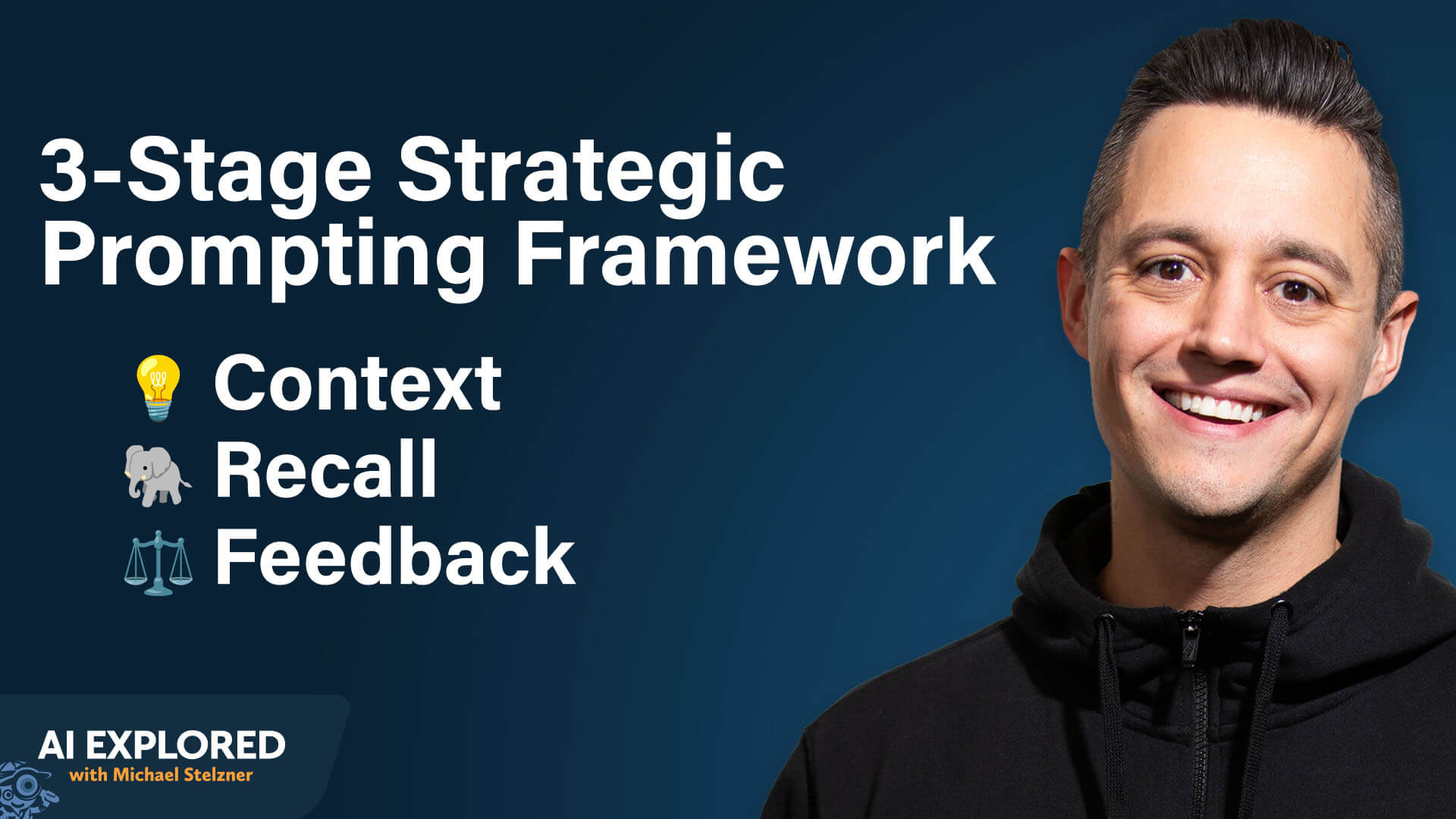
Rethinking Prompting: Getting AI to Work for You
The internet is filled with supposed magic prompts that promise perfect AI outputs. Jordan Wilson sees this misconception constantly in his work, helping companies adopt AI tools.
The fundamental problem is context. When someone shares a prompt that generated great results for them, they're only sharing the surface-level instructions. They're not sharing their conversation history, their accumulated context, or the back-and-forth refinement that led to that prompt actually working.
Jordan compares this misuse of AI to buying a Ferrari just to use it as an umbrella to shield yourself from the rain. You're technically using the tool, but you're completely missing what makes it powerful. If all you needed was protection from rain, you could have bought an umbrella for that.
What to Consider Before You Begin
The biggest mistake people make is treating ChatGPT, Claude, or Gemini as a smarter version of Google search. Jordan points out that this is the absolute worst way to use these tools because you're just trying to get a quick answer rather than engaging in the collaborative process these models are designed for.
He suggests thinking about AI more like working with a consultant from a big four consulting company on a project. You'd have a conversation, train them on your specific context, give them openings to ask questions, and iterate along the way.
The other critical consideration is using the right model for the task. Jordan emphasizes that different models have different strengths. Gemini Pro is ridiculously good with images. Claude is superior at writing. Yet many people still use only ChatGPT because it was the first tool they learned, then blame the tool when it underperforms.
Jordan recommends spending time understanding which model best handles the specific workflows for your needs. You might even have access to these tools through your workplace, as Microsoft Copilot or Gemini is built into your system.
The key mindset shift is to accept that great AI outputs require upfront investment. You're not saving time by rushing to an output. You're saving time by building reusable context that improves every subsequent interaction.
Prime Your Model With Strategic Context
Priming is the foundation of Jordan's three-step framework called Prime Prompt Polish. This is where you teach the AI what it needs to know before you ever ask it to produce anything.
First, tell the model what role it should play and what expertise it should draw from. That specificity completely changes how the model approaches subsequent questions.
Next, provide a comprehensive background about your industry, your target audience, your current challenges, and your goals. If you're creating content, explain your brand voice. If you're solving a business problem, describe your constraints.
The critical instruction Jordan always includes is telling the model not to produce an output yet. He tells the model he doesn't want the SWOT analysis yet, doesn't want the KPI dashboard, and doesn't want the financial breakdown yet. First, he asks ChatGPT to ask him every single question it has based on the context he's shared.
This prevents the AI from jumping ahead and instead creates a back-and-forth that builds a comprehensive understanding.
Critical Instruction — Read Carefully Do NOT create the SWOT, dashboard, financial model, or strategy yet. Your task right now is NOT to produce an output. Instead, based solely on the context above and your expertise: 1: Identify every question you need answered in order to produce a high-quality, accurate, and useful result. 2: Ask those questions in a structured, grouped way (for example: Strategy, Operations, Financials, Market, Constraints, Metrics, Risks). 3: Do not make assumptions. 4: Do not suggest solutions. 5:Do not preview or outline the final deliverable. When you're finished, stop and wait for my responses. I will answer your questions, and only after that will I explicitly ask you to produce the final output.
Other topics discussed include:
-
Providing Examples of What Good and Bad Look Like
-
Uploading Reference Documents and Data
-
Describing Your Audience and Their Needs
-
Setting Clear Expectations for Format and Scope
-
Prompting With Recall
-
Polishing Through Iterative Feedback
-
Maintaining Your AI Systems Over Time
Today's advice provided with insights from Jordan Wilson, a featured guest on the AI Explored podcast.

Unlock AI Marketing Breakthroughs, Alluser! 🚀
If you're like most of us, you are trying to figure out how to use AI in your marketing. You've likely heard people say that AI can boost your productivity and improve your marketing—all while saving you time.
BUT HOW?
Introducing the AI Business Society—an AI marketing community from your friends at Social Media Examiner. The AI Business Society is your secret weapon for boosting your productivity, unlocking your creativity, and becoming a truly indispensable AI-powered marketer.
Ready to find out more?
Yes, I want ALL the details.

Anthropic Launches Claude Sonnet 4.6: Anthropic has introduced Claude Sonnet 4.6, its most capable Sonnet model to date, delivering upgrades across coding, long-context reasoning, computer use, and agent planning while maintaining previous pricing. Now the default model across Claude's Free and Pro tiers, Sonnet 4.6 features a 1 million token context window in beta and demonstrates strong performance gains over its predecessor—often rivaling or surpassing Opus 4.5 in user evaluations. The release also expands developer tools, including adaptive thinking, context compaction, improved web search execution, and Excel MCP integrations. Anthropic
ChatGPT Adds Lockdown Mode and Elevated Risk Labels to Strengthen Security Controls: OpenAI has introduced Lockdown Mode, an optional advanced security setting designed for high-risk users such as executives and security teams, to mitigate prompt injection and data exfiltration threats. Available across ChatGPT Enterprise, Edu, Healthcare, and Teachers plans, the feature deterministically restricts certain tools—including limiting web browsing to cached content—and gives administrators granular control over app access. Alongside this, OpenAI is standardizing "Elevated Risk" labels across ChatGPT, ChatGPT Atlas, and Codex to clearly signal features that may introduce additional network-related risks, empowering users to make informed security decisions. OpenAI
Codex-Spark Brings Real-Time AI Coding to ChatGPT Pro: OpenAI has launched GPT-5.3-Codex-Spark, its first model purpose-built for real-time coding, delivering ultra-fast responses at over 1,000 tokens per second through a partnership with Cerebras. Designed for interactive development, the model enables near-instant edits, rapid iteration, and lightweight collaboration within Codex, while also benefiting from broader system-level latency improvements across OpenAI's infrastructure. Available as a research preview to ChatGPT Pro users, Codex-Spark introduces a new low-latency tier for developers and signals a shift toward blending long-running autonomous coding with real-time AI collaboration. OpenAI
What Did You Think of Today's Newsletter?
Michael Stelzner, Founder and CEO
P.S. Add
michael@socialmediaexaminer.com into your contacts list. Use Gmail?
Go here to add us as a contact.
We publish updates with links for our new posts and content from partners. Your information: Email:
tukangpostemel@gmail.com Opted in on: 2021-09-06 17:03:43 UTC.




