Today's Guide to the Marketing Jungle from Social Media Examiner...
presented by 
Here's a recap of the most important insights, trends, and updates you need to know about today, Alluser! Catch up in minutes and go into the rest of the week prepared.
In today's edition:
-
Color trends for marketers
-
The AI trust signals that get your business recommended in consumer searches
-
🗞️ Industry news from Google, Pinterest, TikTok, and more

5 Colors to Use in Your Marketing This Year
What if color wasn't just a design choice—but a business signal?
Pinterest's 2026 Palette™ is more than a mood board. This year's five standout shades aren't just trending; they reflect a deeper emotional shift in how people want to feel and what they want their lives to look like.
For marketers trying to decode consumer behavior, these hues offer a vivid glimpse into the psyche of 2026 audiences: bold, expressive, and seeking emotional utility in everything from fashion to digital experiences.
But what does that mean for your brand's visual storytelling? If you're still defaulting to safe neutrals, you could be missing a major moment. The demand for vibrant, emotion-driven aesthetics is rising, and platforms like Pinterest are surfacing exactly how people are choosing to engage.
Whether you're crafting your next campaign, choosing a brand refresh palette, or simply watching what's next, this year's colors carry more weight than meets the eye.
Curious what each shade signals—and how to tap into the emotional trends behind them? Read more here.
Recommended or Rejected: Does AI Trust You
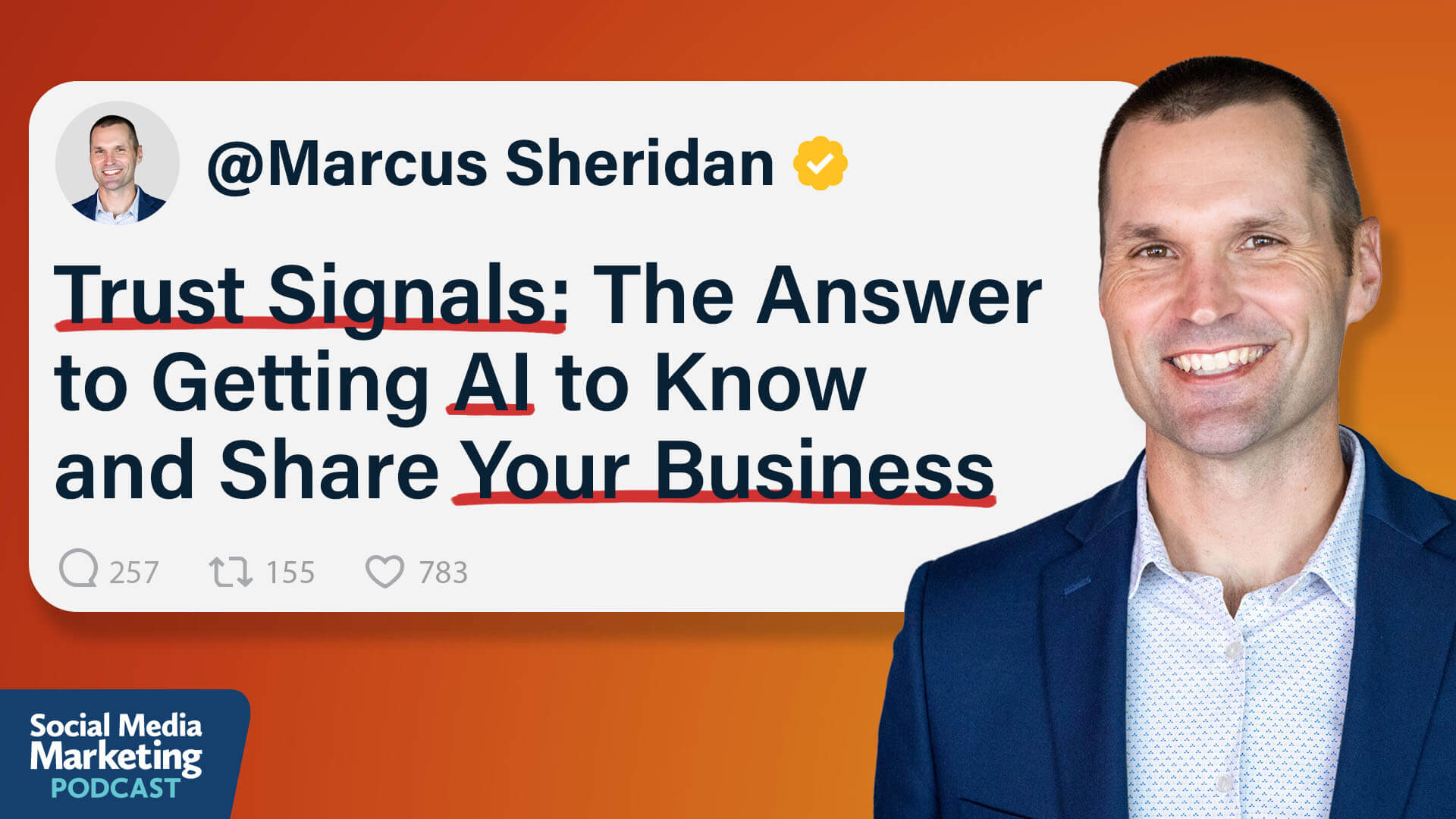
Getting AI to recommend you comes down to trust signals. A trust signal is any piece of content ever produced online about your company—by you or by someone else.
Every review ever written about your company, whether positive or negative, is a trust signal. Every piece of content you produce, every article on your website, every video out there, the different tools you have on your site, and everything said about you—these all become trust signals.
Think of your AI trust score like a credit score. Just as there are things that ding your credit and things that build your credit in finance, it's the same with how AI views your brand. AI is getting much better at consuming all these signals—whether on social media, YouTube, or your website.
But here's the critical distinction: AI doesn't rank businesses the way Google does. There's no such thing as "ranking first" in AI. If AI sees your brand as having an authority score on particular subject matter or a particular area, then you're likely to be mentioned based on that score.
Here's another important factor: every AI account is different. You and someone else could do the exact same search right now and get different answers. Your AI has been trained on you, and theirs has been trained on them. AI understands every user uniquely.
It'll get to the point where AI can tell if you're a high-end, quality-driven buyer or a budget-minded buyer. Your AI will learn about you and recommend businesses consistent with your buying history and past themes. Google never did that.
There are many types of AI trust signals grouped into three tiers: technical signals, authority-based signals, and brand-based signals. Let's explore how to get started with this tier.
Strengthening Authority Trust Signals With Pricing Transparency
Authority-based signals help AI understand your brand's market authority. One of the most powerful authority signals you can build is pricing transparency.
AI understands that the foremost question every single consumer has—the first question of the buyer's journey—is roughly "What's this going to cost?"
You need three things to build strong pricing authority signals:
A Robust Pricing Page: Create a pricing page that explains value in your industry, what drives costs up and down, and discusses ROI. Don't just list prices—help people understand pricing in your industry.
The River Pools story illustrates this perfectly. When the housing market crashed in 2008 and the pool business was dying, the company started answering every question customers were asking—including pricing questions. They created content like "How much does a fiberglass pool cost?" with real numbers and pricing ranges.
Competitors thought this was crazy. Why would you give away pricing information? But this transparency made River Pools the most trafficked swimming pool website in the world and turned the company around.
A Pricing Video: Video content amplifies your pricing authority. Create video content that walks people through pricing considerations, helping them understand the factors that influence costs in your industry.
A Pricing Estimator: Interactive pricing estimators and calculators are becoming increasingly critical. Already, when you do service-based searches on your cell phone, you're seeing "Have AI check prices." Click that, and the AI asks you a series of questions, goes to contractors to get information, and comes back with a report—without you ever engaging the contractor directly.
AI will soon show you in the AI summary which contractors near you have an estimator on their site based on what it was able to see and read.
Tools like Common Ninja and Ion Interactive help you build these calculators without coding knowledge. You can create estimators for virtually any product or service—pool installations, software implementations, consulting packages, manufacturing quotes, and more.
Additional Authority Signals: Other authority signals include whether you're on Google page one for that particular thing (though this isn't something you can just go fix immediately) and the accuracy of your claims.
AI really cares about the accuracy of claims. If you say, "I am the most successful coach for stay-at-home moms who are coming back into the workforce," AI doesn't like that unless you back it up with proof.
AI will ding you if you have a claim that's not backed by some type of proof. However, if you say "I won this particular award for top ten coaches in the world for this particular niche" and then you source back to it, that's an authoritative outbound citation—a major trust signal that helps prove the accuracy of the claim.
You can't just make claims anymore without backing them up. Every claim needs supporting evidence that AI can verify.
Other topics discussed include:
-
Why AI Visibility Is the Future of Online Discovery
-
The Opportunity Right Now: AI Trust Signals
-
Building Technical Trust Signals With Schema Markup
-
Maximizing Brand Trust Signals Through Reviews and Recognition
-
Auditing Your AI Visibility With Testing Tools
Today's advice is provided with insights from Marcus Sheridan, a featured guest on the Social Media Marketing Podcast.

Google Expands Demand Gen Campaign Features: Google's January Demand Gen update brings several new features to general availability, including Shoppable CTV, which enables viewers to browse and purchase products via YouTube ads on connected TVs. Advertisers can now also track campaign-driven branded searches and use Travel Feeds to generate dynamic hotel ads with real-time info. Demand Gen has shown strong results for brands like LG Electronics, outperforming paid social in conversion rates and CPA. These tools aim to help marketers more effectively turn viewer engagement into action. Google
Pinterest Launches Built-In Media Planner for Campaign Forecasting: Pinterest has introduced a new Media Planner tool within Ads Manager, aimed at simplifying campaign planning for brand awareness and consideration objectives. The tool enables marketers to identify target audiences, estimate budget-based performance metrics, and compare scenario outcomes across formats and timeframes. Pinterest
Pinterest Defeats Copyright Lawsuit Over Off-Platform Notifications: A U.S. District Court has ruled in favor of Pinterest in a copyright lawsuit filed by photographers who claimed the platform infringed their works by displaying images in off-platform notifications. The plaintiffs had narrowed their complaint to focus solely on how Pinterest used copyrighted photos in emails and push alerts. Pinterest argued its conduct was protected by DMCA safe harbor provisions, and the court ultimately agreed, granting summary judgment on January 5, 2026. The case underscores evolving copyright questions around content distribution beyond traditional web and app interfaces. Bloomberg Law
Threads Overtakes X in Mobile Daily Active Users: Meta's Threads has edged past X in mobile daily usage, reaching 141.5 million daily active users on iOS and Android, according to Similarweb. The growth is driven by Meta's strategic cross-promotions, creator-focused tools, and a steady rollout of new features, including long-form posts and DMs. While Threads remains weak on the web, where X still commands 145.4 million daily visits, the mobile lead marks a significant shift. TechCrunch
Threads Ads Expand Globally: Meta is launching ads on Threads to users in all global markets starting next week, building on the platform's rapid growth to over 400 million monthly active users. Threads ads will appear in-feed using Meta's AI-powered system, offering personalized ad placements similar to Facebook and Instagram. Advertisers can integrate Threads into existing campaigns via Ads Manager, with support for various formats including carousel, 4:5 ratio, and Advantage+ catalog/app ads. Meta is also rolling out simplified account management and third-party brand safety verification to enhance confidence and control for advertisers. Meta
TikTok Forms U.S.-Based Joint Venture to Meet National Security Mandates: TikTok has launched TikTok USDS Joint Venture LLC, a majority American-owned entity formed to comply with a 2025 U.S. Executive Order focused on data security and national oversight. The venture is designed to protect U.S. user data and algorithm integrity through Oracle's cloud infrastructure, rigorous cybersecurity protocols, and independent content moderation. It will also manage U.S. operations for other apps like CapCut and Lemon8. Led by CEO Adam Presser and governed by a U.S.-majority board, the initiative aims to secure the platform's future in the U.S. market. TikTok
TikTok Launches Streaming Ads: TikTok has unveiled Streaming Ads, a Smart+-powered solution designed to help streaming services convert viewer interest into new subscriptions. The ad format showcases multiple titles through dynamic experiences like Media Cards and Multi-Show carousels, optimized in real-time using intent signals. Streaming Ads enable performance-driven targeting and easy setup through TikTok Ads Manager. TikTok
TikTok Expands Pulse Suite for Culturally Relevant Ad Placements: TikTok has enhanced its Pulse Suite, enabling brands to appear next to the platform's most culturally impactful content through Pulse Premiere and Pulse Core. Pulse Premiere aligns ads with premium publisher content from partners like Formula 1 and Warner Bros Discovery, while Pulse Core leverages real-time trends and high-performing user content across preset and custom categories. TikTok
TikTok Launches Q1 2026 Brand Tools for Smarter Campaigns and Insights: TikTok's Q1 2026 Product Preview introduces a suite of updates aimed at helping brands streamline operations, scale creative, and improve mid-funnel performance. New Registered Business Accounts unlock profile features and brand safeguards, while Partner Exchange simplifies creative collaboration within TikTok One. Creative for Smart+ now includes Auto-select for app campaigns, automating asset selection for better outcomes. TikTok Market Scope expands with deeper analytics across commerce, entertainment, and telecom sectors. Updates to Brand Consideration and Traffic campaigns enable improved targeting of high-intent audiences. TikTok
X Open Sources Algorithm: X has published its updated feed-ranking algorithm on GitHub, offering a detailed look at how it surfaces both organic and ad content using Grok-based AI. The system prioritizes user engagement signals and filters out undesirable posts without any manual tuning. While the move is framed as a transparency milestone, it arrives as the company faces intense criticism over Grok's role in generating deepfake content and a $140 million EU fine for transparency violations. Some view the open-sourcing as a strategic move to manage public and regulatory perception. TechCrunch
YouTube Unveils 2026 Vision: AI Tools, Shopping Features, and Creator-Led TV: YouTube CEO Neal Mohan shared the platform's 2026 roadmap, highlighting a push to redefine entertainment through creator-driven content and customizable experiences across devices. New features include AI-powered tools for Shorts, games, and music creation, as well as enhanced protections against misleading synthetic media. YouTube is also deepening parental controls and expanding revenue streams with in-app shopping, brand deal tools, and fan funding upgrades. YouTube
YouTube Streamlines Content Management and Settings UI: YouTube is simplifying its mobile app by consolidating content management tools onto the channel page. The "Manage Videos" option is being removed, and creators will now manage all videos, Shorts, and live streams directly from their channel page after uploading content. Additionally, YouTube is rolling out a redesigned video settings interface with expandable grouped fields to improve usability. Shopping program participants will also benefit from a new product tag field. YouTube
What Did You Think of Today's Newsletter?
Michael Stelzner, Founder and CEO
P.S. Add
michael@socialmediaexaminer.com into your contacts list. Use Gmail?
Go here to add us as a contact.
We publish updates with links for our new posts and content from partners. Your information: Email:
tukangpostemel@gmail.com Opted in on: 2021-09-06 17:03:43 UTC.




