Today's Guide to the Marketing Jungle from Social Media Examiner...
presented by 
Friday is almost here, Alluser! Before you unplug, here are the latest AI insights and updates for marketers. Whether you read them now or save them for later, you won't want to miss these.
In today's edition:
-
How to build a full website with just AI—no coding
-
Discover the tools you'll need to deploy AI voice agents
-
🗞️ Industry news from Anthropic, OpenAI, and more

Build a Website With Claude & Replit
Think building a sleek, high-performing website still means hiring a dev team or wrestling with WordPress? Think again. Isar Matis takes us behind the scenes of how he built a fully functional, design-forward site—without writing code from scratch and without outsourcing a single step.
He walks through using tools like Claude and Replit to go from idea to prototype to polished final product—all while customizing transitions, building dynamic themes, and even creating his own web editor along the way.
If you're curious how far you can push AI for real-world marketing or product execution—without ballooning costs or tech headaches, this episode is a blueprint worth bookmarking. Watch more here.

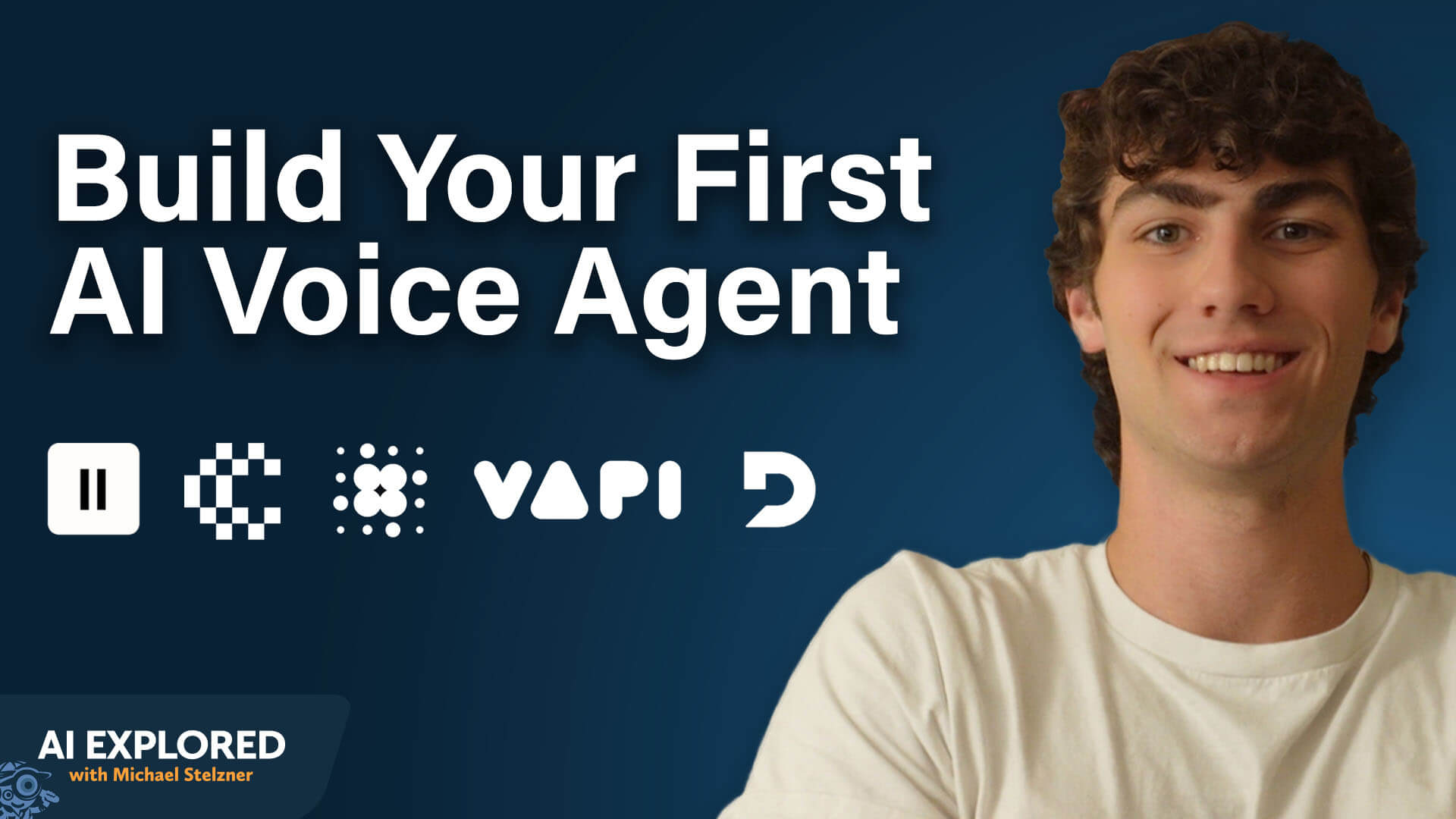
AI Voice Agents: How to Get Started
AI voice agents cost eight to twelve cents per minute. Compare that to human phone staff, and you'll almost always see a clear ROI.
At approximately ten cents per call, use cases that were previously economically impossible suddenly become viable, enabling proactive customer service, extensive lead follow-up, and large-scale reactivation campaigns that would never work with human staff.
Beyond the core conversation loop, you can integrate different business functions. The agent can update your CRM, log calls into Google Sheets, or send emails based on the conversation content. This is where voice agents become true business tools rather than just talking systems.
The businesses implementing voice agents now gain significant competitive advantages in customer service, lead qualification, and operational efficiency.
The technology is ready. The question is whether you're ready to implement it. Below, you'll discover what you'll need to build each part of your AI voice agent for phone calls.
How AI Voice Agents Work
A voice agent consists of three different core conversation components working in unison within an AI voice agent platform to create an interactive agent that can respond dynamically to customer questions and even handle objections.
The Ears: The ears are speech-to-text technology. This component transcribes whatever the person on the other line says and converts it to text.
The Brain: The brain is an LLM (large language model) like GPT. This component is text-to-text. It takes the transcribed response, runs it through whatever instructions you've given the agent, and then outputs what you want it to respond with.
The Mouth: The mouth is text-to-speech technology. This component gives voice to the text the brain generated and speaks it back to the human. The entire process happens within about a second.
How Latency Affects Your AI Agent's Performance
The ear, brain, and mouth layers of voice agents each contribute to latency:
-
Speech-to-text typically adds one hundred to two hundred milliseconds of latency.
-
LLM latency varies significantly. For example, using ChatGPT 5.2 versus 5.2 Nano can create a three to four hundred millisecond difference.
-
Voice contributes three hundred to four hundred milliseconds.
Human speech typically ranges from eight hundred milliseconds to a second. You want your agent to respond within that range, so balancing the combined latency between the models is key to optimal performance.
Choose Your AI Voice Agent Tech Stack: Recommendations
No-Code Voice Agent Platforms
This tool provides the infrastructure to choose and connect your speech-to-text (ears), LLM (brain), and text-to-speech (mouth) models. You simply choose each model from the relevant options. Once you return to the agent screen, you'll see the total cost and total expected latency for your agent. You can experiment with different model combinations to find the optimal balance of performance and cost.
The three main platforms for building no-code voice agents are Retell AI, Vapi, and ElevenLabs' own agent builder; they bring together the ears, mouth, and brain components you choose so you don't have to write code.
All three platforms are entry-level tools that let you create a free account to get a demo up and running.
Tommy Chryst favors Retell AI for almost every project due to its user experience and the company's track record with uptime. When you're running calls 24/7 for your business, it's critical that the infrastructure doesn't go down.
The Ears: Speech-to-Text Model
These tools offer industry-specific modes, such as medical terminology, so they can recognize and transcribe specialized vocabulary that standard transcription wouldn't normally handle correctly.
You can also configure custom keywords in your transcription settings. For example, if the AI mispronounces or mistranscribes your company name or product terms, you can add these to a recognition library so they're transcribed correctly every time.
Be aware that some voice agent platforms may not allow you to switch away from their default speech-to-text transcription provider, but when you can, Chryst recommends Deepgram.
The Brain: LLM Model
Don't assume that the newest model of an LLM will work better for your voice agent. When a brand new LLM launches, the initial traffic surge from users eager to test it can create problems for you.
Chryst's agency primarily uses ChatGPT, and he says GPT 4.o performs consistently, but notes 5.1 is getting more consistent now that 5.2 has launched and taken some of the traffic load off 5.1.
The Mouth: Text-to-Speech Model
ElevenLabs has long been the leader in text-to-speech. However, other companies are catching up.
Cartesia represents a strong alternative. Their newest voice model performs exceptionally well for voice AI applications. Their newest voice model is faster and less expensive than ElevenLabs and delivers comparable sound quality.
Other topics discussed include:
-
How to Use Your AI Voice Agent: Inbound and Outbound Use Cases
-
Legal Considerations for AI Voice Agents
-
Planning the Build of Your AI Voice Agent
-
Testing Your AI Voice Agent
Today's advice provided with insights from Tommy Chryst, a featured guest on the AI Explored podcast.


Google Debuts AI Ultra Subscription for Advanced AI Access: Google has unveiled Google AI Ultra, a $249.99/month subscription that offers creators, researchers, and professionals access to its most powerful AI models and tools. The plan includes top-tier capabilities across Gemini, Flow, Veo 3, and Whisk, along with deep research features, cinematic video generation, and advanced Chrome integration. Subscribers also receive Project Mariner, 30 TB of cloud storage, and YouTube Premium. Google AI Pro, the rebranded AI Premium plan, is also gaining new features. Google
OpenAI Launches Prism Writing Tool with GPT-5.2: OpenAI has introduced Prism, a free cloud-based workspace for scientific writing and collaboration built on GPT-5.2. Designed for researchers, Prism combines LaTeX editing, real-time co-authoring, and AI-powered drafting into a unified environment. Users can test hypotheses, generate citations, revise full documents, and integrate equations or figures seamlessly—without switching between tools. Prism supports unlimited collaborators and is available now to anyone with a ChatGPT account, with broader access coming for enterprise and education plans. OpenAI
Google Search Rolls Out Seamless Conversational AI with Gemini 3: Google has upgraded its Search experience to support more natural and complex queries, powered by the Gemini 3 model now set as the default for AI Overviews globally. Users can now shift effortlessly from standard search results into a conversational flow using AI Mode, which retains context for follow-up questions. The update, available globally on mobile, is designed to blend quick answers with deeper exploration, making Search more intuitive and interactive. Google
Anthropic Adds Slack, Canva, and More to Claude with New App Integrations: Anthropic has rolled out interactive Claude apps, letting subscribers integrate workplace tools like Slack, Canva, Figma, and Box directly into Claude's chat interface. These apps enable actions such as sending messages or editing designs without leaving the conversation. Built on the Model Context Protocol, the apps system is designed for productivity and is set to integrate with Claude Cowork, Anthropic's multi-stage task agent. The feature is available now for paid Claude users, with Salesforce and further app support expected soon. TechCrunch
Google Rolls Out Personalized AI Search via Gmail and Photos Integration: Google has launched Personal Intelligence in AI Mode for Search, enabling AI Pro and Ultra subscribers to connect Gmail and Google Photos for uniquely tailored responses. The feature personalizes queries using contextual insights—like recommending coats based on travel plans or suggesting restaurants tied to past memories. This opt-in feature is powered by Gemini 3 and ensures user control and privacy, with no direct training on inboxes or photo libraries. Initially available as a Labs experiment for U.S. personal accounts, it's designed to turn Search into a more helpful, individualized tool. Google
Anthropic Publishes New Constitution to Guide Claude AI Behavior: Anthropic has released a comprehensive new constitution for its Claude AI models, detailing the values and behavioral principles that shape the system's outputs. Unlike prior versions, the updated constitution emphasizes context and reasoning, aiming to help Claude apply broad ethical judgments rather than follow rigid rules. It includes guidance on balancing safety, honesty, helpfulness, and Anthropic's internal guidelines, as well as new tools to handle complex moral scenarios. Released under a Creative Commons license, the constitution also serves as a transparency initiative and core training component for Claude's ongoing development. Anthropic
What Did You Think of Today's Newsletter?
Michael Stelzner, Founder and CEO
P.S. Add
michael@socialmediaexaminer.com into your contacts list. Use Gmail?
Go here to add us as a contact.
We publish updates with links for our new posts and content from partners. Your information: Email:
tukangpostemel@gmail.com Opted in on: 2021-09-06 17:03:43 UTC.




